

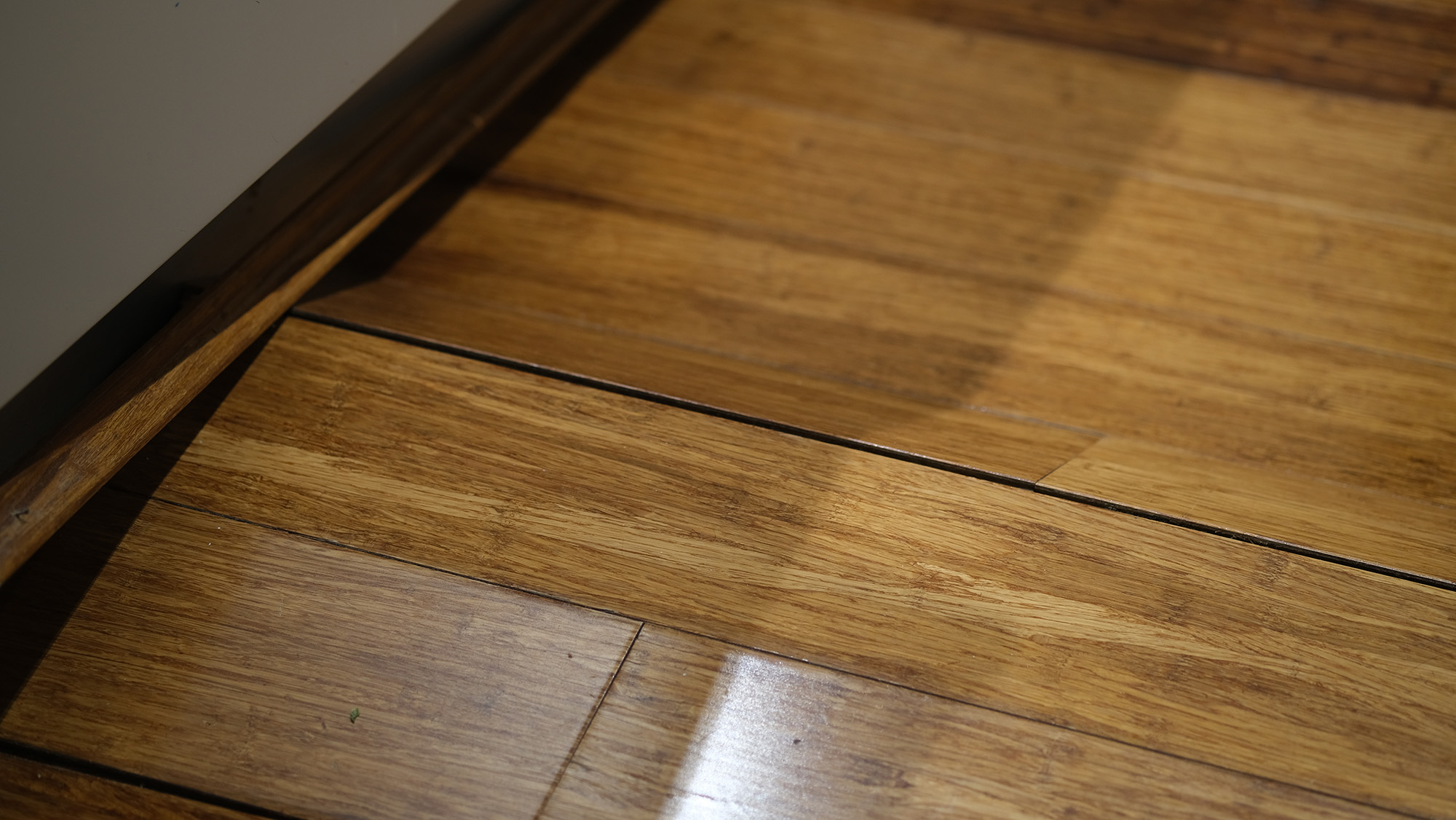
Laminate seam swelling happens when moisture gets into the HDF core at a plank joint, typically from a spill that sat too long, a pet accident near a doorway, or a slow leak from an appliance or window that went unnoticed for a while. The swelling itself is the core fiber physically expanding as it absorbs moisture, which pushes the seam up and apart. The good news is that this damage is almost always localized to the planks that actually got wet, not the entire floor.
Confirming The Damage Is Actually Contained
Before assuming a full floor replacement, press gently on the planks surrounding the swollen seam and check for any softness, movement, or give underfoot that extends beyond the visibly affected area. Swollen planks feel distinctly different from healthy ones, slightly spongy rather than solid, and that difference is usually obvious once you know what to feel for.
Most isolated incidents, a dropped glass of water, a quick pet accident, a one time appliance leak that got cleaned up promptly, affect only the one or two planks closest to where the moisture sat. If the softness and visible swelling stay confined to a small, clearly defined area, you are very likely looking at a plank level repair rather than a room level one.
What A Real Plank Replacement Involves
Laminate installed with a floating floor method can often have individual planks replaced without disturbing the rest of the floor, provided the damaged planks are not locked in too close to a wall or a fixed transition. A installer separates the affected plank or planks from their neighbors at the click lock joint, removes them, and installs new matching planks in their place using the same locking mechanism.
The tricky part is color and sheen matching if your original laminate has had even a few years of UV exposure and normal wear, since a brand new plank can look slightly different from surrounding planks that have aged. This is usually only a minor, barely noticeable difference, but it is worth mentioning honestly rather than promising a flawless, invisible repair in every case.
When It Genuinely Is Not A Simple Fix
A few situations do point toward a larger repair than a plank swap. If the swelling runs along a long continuous seam rather than being contained to a small spot, that usually means moisture traveled further than a single spill would explain, often pointing to a slow, ongoing leak rather than a one time event. In that case, finding and fixing the actual moisture source matters more than the floor repair itself, since replacing planks without addressing an active leak just creates a repeat problem.
Planks locked into the middle of a large room, far from any wall where a repair could start and work outward cleanly, are also more complicated to replace individually, since floating floor click systems are connected across the whole room and removing a plank from deep in the field can require more disassembly than one near an edge.
Press around the swollen area to confirm how far the softness actually extends
Identify and fix the moisture source before replacing any planks, especially for a slow leak
Keep a few leftover planks from your original installation for exactly this kind of future repair
A swollen seam is frustrating, but it is rarely the emergency it looks like at first glance. Most of the time, it is a contained, fixable problem rather than a reason to redo the whole room. Send us a photo of what you are seeing and we can give you an honest read on whether this is a plank repair or something bigger. Contact us to talk through your floor.
R-n-R Flooring and Design repairs and installs laminate throughout Weber, Davis, Morgan, and Salt Lake, UT and Southern Idaho, ID and Southwestern Wyoming, WY, and our team can often match and replace individual damaged planks without a full room tear out. Stop by our showroom at Ogden, UT with photos of your specific issue.


